











Wild Thyme Farm Wetland and Riparian

Wetland and Riparian Habitat

 East Bank Wetlands
  Plastic Remediation
  Digging Out

 West Bank Wetlands
  Stream and Ponds
  New Wetland Habitat

 Garrard Creek
 Conservation
 Reserve Program

  Site Plan
  Budget
  Preparation
  Trees & Scrubs
  Planting Season


The Eastern Wetlands
An ongoing expression of landscape art, creating a variety of wetland environments.

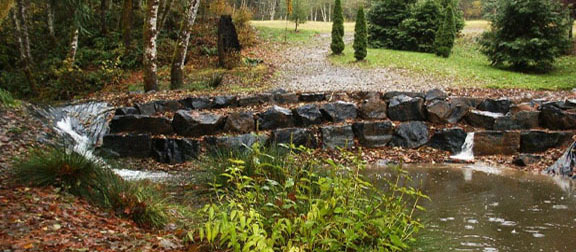
The farm's eastern watershed drains through the ravine in front of the farmhouse, passing under the driveway through a culvert before it enters the creek. Decades of silt accumulation behind the driveway berm has raised the ravine floor, creating a flat expanse through which the stream meanders and oozes, lost in the dense, weedy growth that thrives on the abundant moisture.

Eastern wetlands with plastic cover, Feb 2000
The East Bank Wetlands covered with a layer of black plastic, February 2000

The extremely aggressive, non-native canary reed grass had established a monoculture in this so-called wetland, so we decided to eliminate it in favor of a more diverse, better-behaved collection of moisture-loving plants. Chemical eradication was out of the question, especially because it was an area with water flowing directly into a salmon-bearing creek. Mechanical removal by pulling or digging was hopelessly ineffective. We knew that heavy shade would kill this grass, so we gave it the heaviest shade we could find - a 4000 square foot sheet of 6-mil black plastic.

Pulling back the plastic, Feb 2000
Pulling back the black plastic after one growing season, February 2000

After only one growing season under the plastic, the ever-aggressive canary reed grass, which can get up to 8 feet tall, was reduced to bare muck. We hustled up a work crew and pulled on the heavy, mud-ladenplastic to cover the next infested section of the wetland.

Plastic pulling work party, Feb 2000
Plastic pulling work party, February 2000

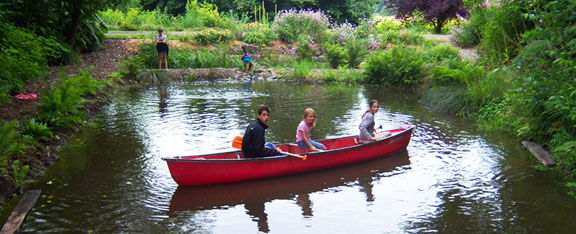
With our new blank, muddy slate, we planted a variety of native and non-native wetland plants in the spring of 2000. An excavator dug a narrow pond along the driveway in the fall of 2000, also placing large boulders as stepping-stones across the pond. Over the winter of 2000/2001, we hand-dug numerous small ponds, channels, berms and islands to create a variety of water depths and soil moisture levels, accommodating as many wetland environments as possible. The restoration process will take the better part of a decade to complete. It is an ongoing and fun work of landscape art, with new designs popping up as we go along.

 
Environment | Visionary Forestry | Stewardship | Wetland Riparian | Agroforestry | Permaculture
Retreat Center | Activities | Friends Family | Art Gallery | Personal Pages | Farm Tour | Home
 
Hana Gardenland | Hana Palms Retreat - Vacation in Paradise in Heavenly Hana, Maui, Hawaii
 
 John Henrikson:john@wildlogic.com | Robert Henrikson: roberthe@sonic.net
Kirk Hanson: agroforestry@earthlink.net | Marisha Auerbach: EarthWiz76@aol.com
www.wildthymefarm.com © 1998, 1999, 2000, 2001, 2002, 2003
72 Mattson Road, Oakville WA 98568 USA. Tel: (360) 273-8892